Why Does My Cat Flatten Its Ears?
DONALD LEE WARNICK | Updated on 04/10/26
Why Does My Cat Flatten Its Ears?
The first time I noticed my cat flattening his ears, I immediately thought something was wrong.
His ears suddenly moved backward, his body became still, and his expression looked completely different from a few seconds earlier.
At first, I assumed he was angry.
Like many new cat owners, I thought flattened ears always meant a cat was upset or ready to attack.
Later, after paying closer attention, I realized that cat body language is much more complicated.
A cat’s ears are one of the most expressive parts of their body.
They can reveal curiosity, excitement, fear, irritation, relaxation, or uncertainty.
The same ear position can mean different things depending on what is happening around the cat.
For example, a cat with flattened ears during play may simply be excited.
A cat with flattened ears while hiding in a corner may be feeling uncomfortable.
Learning to read these small signals has helped me understand my own cat much better.
Instead of reacting immediately, I now look at the whole situation:
-
What is my cat’s body position?
-
Is the tail relaxed or tense?
-
Are the eyes wide or calm?
-
Is my cat trying to move away?
Cats do not communicate with words, but they are constantly sharing information through their behavior.
This article is based on personal experience as a cat owner and general information about feline behavior. It is intended for everyday observation and education only. It does not replace veterinary diagnosis, treatment, or professional behavioral advice.

Quick Answer
Cats flatten their ears for many reasons, including fear, stress, excitement, irritation, focus, or simply reacting to sounds around them.
Flattened ears do not always mean a cat is angry.
The meaning depends on the entire body language of the cat and the situation happening at that moment.
Understanding other signals, such as tail movement, posture, and facial expression, can help owners better understand what their cat is feeling.
Cat Ears Are Built for More Than Hearing
Cats have incredibly flexible ears.
Unlike humans, cats can move their ears in different directions to collect information from their surroundings.
A cat’s ears help them:
-
Detect sounds
-
Locate movement
-
Communicate emotions
-
React quickly to changes
When a cat turns its ears forward, sideways, or backward, they are often responding to something happening around them.
For example, my cat sometimes moves his ears backward when he hears a strange noise outside.
At first, I thought he was upset.
But after watching more carefully, I realized he was simply concentrating.
His body remained relaxed, his tail was normal, and he was calmly listening.
That experience taught me that ear position alone does not tell the complete story.
A cat’s ears are like one part of a larger conversation.
What Do Flattened Ears Usually Mean?
You might like
1. Your Cat Feels Uncomfortable or Unsure
One common reason cats flatten their ears is because they feel uncertain about something.
This may happen when:
-
Meeting a new person
-
Hearing unfamiliar sounds
-
Entering a new environment
-
Seeing another animal
-
Experiencing a sudden movement
A cat may pull their ears backward as a way of showing:
“I am paying attention, and I am not completely comfortable.”
For example, when guests visit my home, my cat sometimes lowers his ears slightly while watching from a distance.
He is not necessarily angry.
He is simply gathering information.
Instead of forcing him to interact, I allow him to approach when he feels ready.
Over time, he usually becomes curious and comes closer.
2. Flattened Ears During Play
One thing that surprises many owners is that cats can flatten their ears while having fun.
During energetic play, cats may show:
-
Backward ears
-
Wide eyes
-
Fast movements
-
Tail movement
This does not always mean aggression.
Many cats become extremely focused while chasing toys.
Their hunting instincts become active, and their entire body prepares for movement.
I notice this when my cat plays with a feather toy.
His ears move backward, his body becomes lower, and he looks very serious.
But a few seconds later, he is relaxing beside me like nothing happened.
The important difference is the rest of his body language.
A playful cat usually returns to a relaxed state quickly.
3. Fear or Stress
Flattened ears can also appear when a cat feels afraid.
A frightened cat may show other signs such as:
-
Lower body posture
-
Wide eyes
-
Hiding
-
Avoiding contact
-
Tail held close to the body
Cats often try to make themselves appear smaller when they feel unsafe.
This is a natural response.
A stressful situation for one cat may not bother another.
Some cats handle visitors easily.
Others become nervous when furniture is moved or routines change.
Understanding your own cat’s personality is important.
4. Irritation or “Please Give Me Space”
Sometimes flattened ears are a clear message that a cat wants a break.
This often happens during petting.
Many cats enjoy affection, but they also have limits.
A cat may initially enjoy being touched but later show signs that they need space.
These signs may include:
-
Ears moving backward
-
Tail starting to flick
-
Skin twitching
-
Looking back at your hand
One mistake I made when I first owned a cat was assuming that if my cat enjoyed petting, he wanted unlimited attention.
I later learned that cats are very good at telling us when they have had enough.
Respecting those signals helps build trust.
5. Your Cat Is Focused on Something
Not every flattened ear position is emotional.
Sometimes cats simply react to sounds.
A cat watching a bird outside the window may move their ears backward while concentrating.
A cat hearing a small noise behind them may adjust their ears without changing their mood.
This is one reason why looking at the entire situation matters.
Acat can have backward ears and still be calm.


Owner Observations: Learning My Cat’s Ear Language
One of the most interesting parts of living with a cat is discovering that small movements can have a meaning.
Before I understood cat body language, I often focused only on obvious behaviors.
If my cat walked toward me, I assumed he wanted attention.
If he walked away, I thought he was simply not interested.
But over time, I realized that his ears were often giving me information before his actions changed.
For example, during quiet evenings, my cat sometimes sits beside me while I gently pet him.
At first, his ears point forward, and he appears completely relaxed.
After several minutes, his ears slowly move slightly backward.
In the past, I would continue because he was still sitting there.
Later, I learned that this small change was his way of saying he was becoming less comfortable.
Now, when I notice the signal, I stop and give him a little space.
Often, he stays nearby and returns for attention later.
This simple adjustment improved our relationship because I learned to respect his communication instead of only focusing on what I wanted.
Real Cases: Different Cats, Different Meanings
A friend of mine adopted a shy rescue cat named Luna.
During the first few weeks, Luna often walked around the house with her ears slightly flattened.
My friend originally thought Luna was always scared.
However, after spending more time observing her, she noticed something interesting.
Luna’s ears changed depending on the situation.
When visitors arrived, her ears flattened because she felt uncertain.
When she played with toys, her ears moved backward because she was focused.
When she relaxed in her favorite sleeping area, her ears returned to a normal position.
The same ear movement appeared in different situations, but the meaning was not always the same.
Another cat owner shared a similar experience with a young kitten.
The kitten flattened its ears whenever it played with another cat.
At first, the owner worried that the kittens were fighting.
After watching more carefully, they noticed both cats were taking turns chasing each other, stopping naturally, and returning to play.
The flattened ears were part of their excited play behavior.
These examples show why one signal should not be viewed alone.
Cats communicate through combinations of behaviors.
Understanding Different Ear Positions
Learning a few common ear positions can make it easier to understand your cat.
Forward-Facing Ears
When a cat’s ears point forward, they are usually interested or curious.
You may notice this when your cat:
-
Watches a bird outside
-
Hears a new sound
-
Explores something unfamiliar
This often means your cat is gathering information.
Sideways Ears
Sometimes called “airplane ears,” sideways ears may happen when a cat feels uncertain, annoyed, or overwhelmed.
You may notice this during:
-
Busy environments
-
Loud noises
-
Too much handling
The rest of the body language matters.
A relaxed cat with sideways ears may simply be listening.
A tense cat with sideways ears may want more space.
Flattened Backward Ears
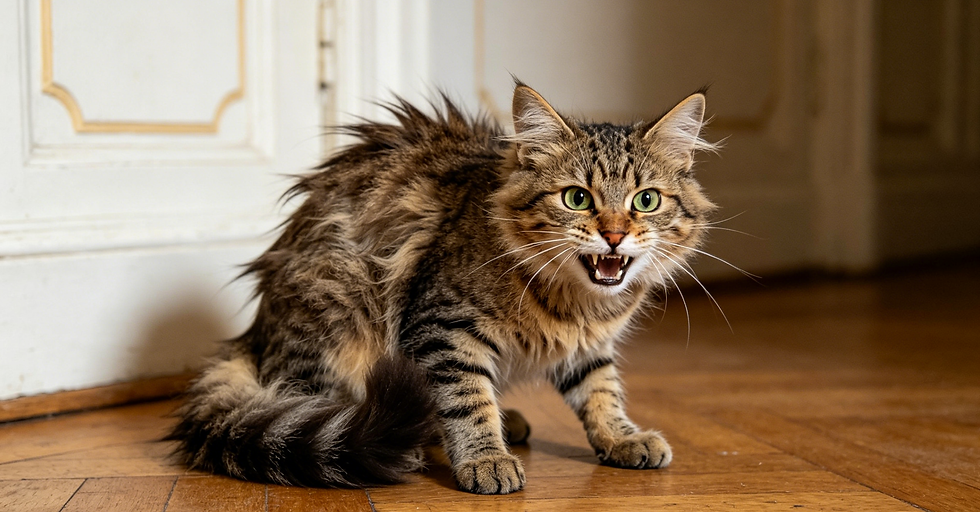
When ears are pressed tightly backward, cats may be showing stronger emotions.
Possible reasons include:
-
Fear
-
Stress
-
Frustration
-
Defensive behavior
This is usually a sign to slow down and observe what is happening.
Giving your cat distance is often better than trying to force interaction.
When Should You Pay Attention?
Flattened ears are not automatically a problem.
Cats use this behavior as normal communication.
However, owners may want to pay closer attention when ear changes happen together with other unusual behaviors.
Things worth noticing include:
-
Sudden personality changes
-
Hiding more than usual
-
Loss of interest in normal activities
-
Changes in eating habits
-
Avoiding touch
-
Signs of discomfort
For example, a cat that briefly flattens its ears during play is very different from a cat that constantly appears tense and avoids interaction.
The most useful information comes from changes in your cat’s normal routine.
How Should You Respond When Your Cat Flattens Its Ears?
The best response depends on the situation.
Give Your Cat Space
If your cat’s ears flatten while you are petting them, consider stopping for a moment.
Allow your cat to decide whether they want more interaction.
Respecting boundaries helps build trust.
Look at the Whole Body
Do not judge your cat only by ear position.
Also look at:
-
Tail movement
-
Body posture
-
Eyes
-
Facial expression
-
Vocal sounds
A cat with flattened ears and a relaxed body is different from a cat with flattened ears, a stiff posture, and a rapidly moving tail.
Avoid Punishing the Behavior
A cat is not being “bad” when they flatten their ears.
They are communicating.
Punishing your cat for showing discomfort may make them less likely to communicate clearly in the future.
Instead, try to understand what caused the reaction.
Final Thoughts
Cats may not speak our language, but they are constantly communicating.
Their ears, tails, eyes, and body movements all provide clues about how they feel.
When a cat flattens its ears, it does not always mean anger.
It may mean:
-
“I am unsure.”
-
“I am focusing.”
-
“I need some space.”
-
“I am excited.”
The biggest lesson I have learned as a cat owner is that understanding behavior takes patience.
A single movement rarely explains everything.
The best way to understand your cat is to observe patterns over time.
After learning my own cat’s signals, I became better at knowing when he wanted attention, when he wanted space, and when something in his environment was bothering him.
Small changes in body language can create better communication between cats and humans.
By paying attention to these signals, we can create a calmer and more trusting relationship with our cats.
References
-
Cats.com – Why Do Cats Put Their Ears Back?
https://cats.com/why-do-cats-put-their-ears-back -
American Association of Feline Practitioners (AAFP)
https://catvets.com/ -
Cornell Feline Health Center
https://www.vet.cornell.edu/departments-centers-and-institutes/cornell-feline-health-center -
International Cat Care (iCatCare)
https://icatcare.org/ -
Merck Veterinary Manual – Ear Disorders in Cats
https://www.merckvetmanual.com/ -
VCA Animal Hospitals – Understanding Cat Behavior
https://vcahospitals.com/know-your-pet
FAQ
1. Why does my cat flatten its ears when I pet it?
If your cat suddenly flattens its ears while being petted, it may be feeling overstimulated or uncomfortable. Some cats enjoy affection for only a short time before they need a break. Watch for other signs like tail flicking, tense muscles, or attempts to move away.
2. Do flattened ears always mean my cat is angry?
No. While flattened ears can signal fear or aggression, they can also appear when a cat is startled, focused on a sound, playing, or experiencing discomfort. It's important to look at your cat's overall body language and the situation.
3. Why does my cat flatten its ears before running around the house?
Many cats briefly flatten their ears just before getting the "zoomies." This playful body posture often happens before they sprint, jump, or chase imaginary prey. If your cat otherwise looks relaxed and playful, it's usually nothing to worry about.
4. Should I touch my cat when its ears are pinned back?
It's usually best to give your cat some space. Ears pinned tightly against the head often mean your cat feels frightened, stressed, or defensive. Trying to pick them up or pet them may increase their anxiety and could lead to scratching or biting.
5. Can flattened ears be a sign of illness?
Yes. If your cat keeps one or both ears flattened for an extended period, especially along with head shaking, scratching, loss of appetite, or changes in behavior, it could indicate an ear infection, ear mites, pain, or another health issue. A veterinary checkup is recommended.
6. Why does my cat flatten its ears during play?
During play, cats often become highly focused and may briefly angle their ears backward while stalking or chasing toys. This is a normal hunting behavior and is different from the flattened ears seen in fearful or aggressive situations.
Related Articles



Donald is a pet care writer and office worker with 5 years of hands-on experience caring for cats and dogs, balancing a busy 9-to-5 schedule with pet parenthood.
Each of his articles draws from real-life wins and learning moments, answering questions busy pet parents face: how to keep pets happy and healthy without extra stress, simple daily habits, budget-friendly tips, and solutions for common issues like picky eating or late-night troubleshooting.